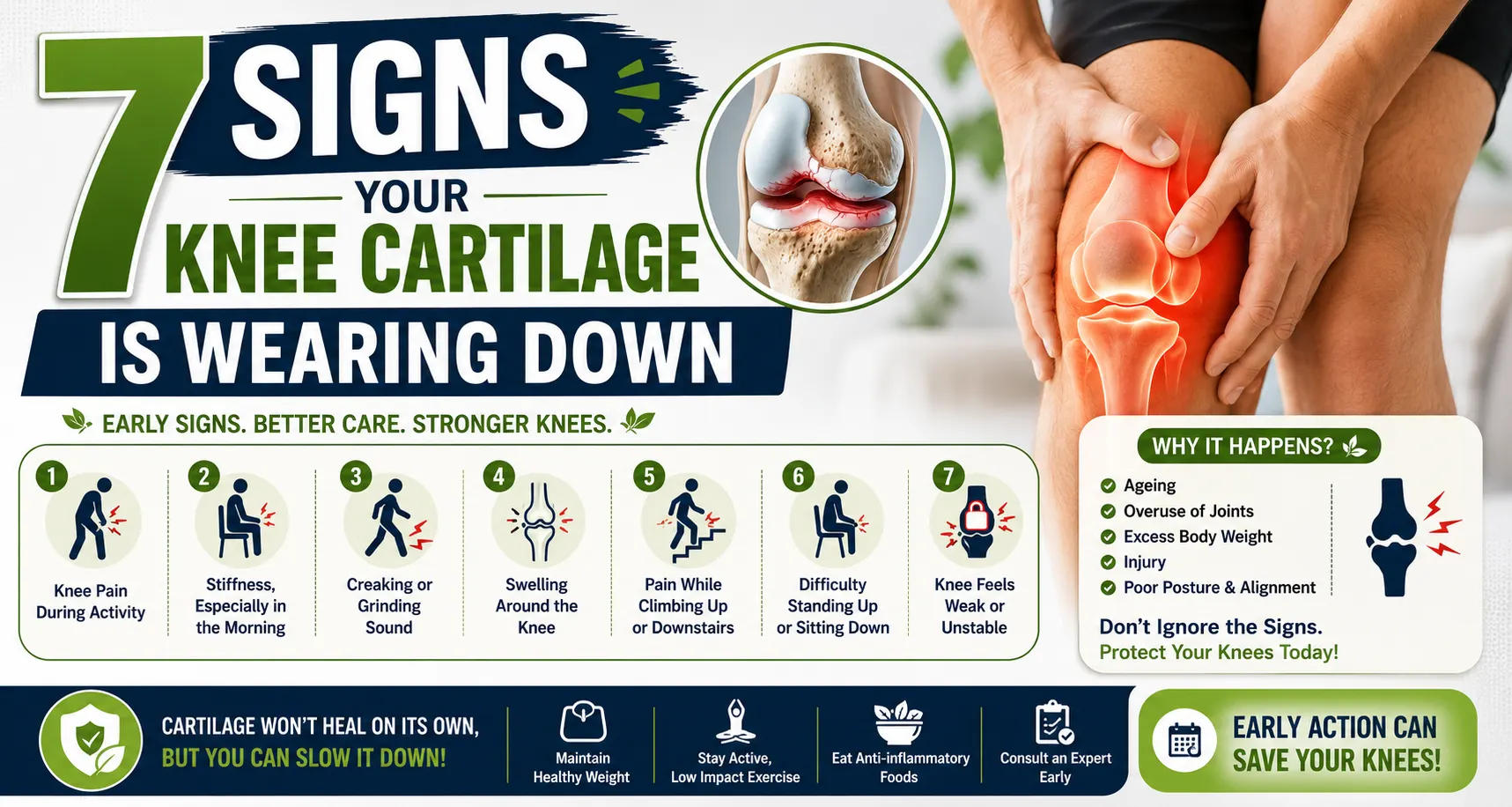
Short answer: if your knees are clicking, aching after a walk, stiff every morning, or just feel "off" when you climb stairs, your knee cartilage is probably thinning out. That's the whole thing in two lines. Now let's actually talk about it, because I know that answer alone isn't going to send you to sleep any easier.
I'll be honest, nobody thinks about their knee cartilage until it starts making noise. Literally. You're going about your day, minding your business, and then one morning you bend down to pick up your phone off the floor, and your knee goes pop like it's cracking its own knuckles. And you just... stand there for a second. Staring at it. Betrayed.
That's usually where this whole rabbit hole starts. A weird sound, a bit of stiffness, maybe some swelling after a long day on your feet. And then you're three tabs deep into "why does my knee hurt" at 11 pm. So, let's save you some of that scrolling. Here's what's actually going on when your cartilage starts wearing thin, and why so many people end up looking at Ayurvedic treatment for knee cartilage instead of just living on painkillers.
Okay but what is cartilage even doing up there
Think of cartilage as the cushiony bit sitting between your thigh bone and shin bone, quietly stopping them from grinding against each other every time you walk, run, sit, or do that weird half-squat thing you do to pick things up because bending your knees fully feels like too much commitment these days. When it's healthy, you genuinely never think about it. Zero thoughts. That's the whole job description, honestly; do your work, stay invisible.
The annoying part is that cartilage doesn't have its own blood supply. Which means once it starts breaking down, your body isn't exactly rushing to fix it the way it would a cut or a bruise. It's slow. Painfully slow, if you'll excuse the pun. Which is exactly why catching the early signs matters so much more than people realize.
The 7 signs, in the order most people actually notice them
1. The grinding or clicking sound (aka crepitus, if you want the fancy word) Every knee pops occasionally, that's fine, don't panic. But if yours is doing it constantly, especially with some discomfort tagging along, that's your cartilage running thin enough that the bones are starting to feel each other out a little too closely.
2. Morning stiffness that takes a solid five minutes to shake off You know the walk. Shuffling to the bathroom like you're a hundred and four years old, and then somehow by the time you've had your coffee you're fine. That "warming up" period is a very classic, very early sign, and it's the one people brush off the longest because it goes away so quickly.
3. Pain that shows up after you've been active, or weirdly, after you've been still A dull ache after a long walk. Or after sitting at your desk for three hours straight, scrolling through things you shouldn't be. Either way, that's cartilage telling you it's not cushioning things the way it used to.
4. Swelling that comes and goes A bit of puffiness around the joint, especially after you've been on your feet, usually means there's inflammation happening in there. It's not always dramatic. Sometimes it's just "huh, that knee looks a little rounder than the other one today."
5. That "is my knee going to give out" feeling This one's a bit scarier than the others. If your knee occasionally feels wobbly or unreliable, like it might just decide not to hold you up on the stairs, that's usually tied to weakened muscles around a joint that's lost some of its cushioning. Don't ignore this one. Genuinely.
6. Locking or catching mid-movement Your knee suddenly sticks while bending, like it forgot the instructions halfway through. This can happen when there's inflamed tissue or bits of worn cartilage getting in the way of smooth movement.
7. You just can't bend or straighten it like you used to Slowly, without really noticing, you stop sitting cross-legged. You stop crouching to tie your shoes and start doing this half-lunge instead. Reduced range of motion creeps in so gradually that most people adjust their whole life around it instead of asking why.
A quick, mildly dramatic comparison
| Situation | Healthy Knee | Knee With Cartilage Wearing Down |
| Climbing stairs | Doesn't even register | Requires a small internal pep talk |
| Sitting on the floor | No issue | A full negotiation process |
| Long walks | Feels good | Feels good, then feels like a mistake |
| Weather changing | Doesn't care | Somehow "knows" before the weather app does |
| Standing up after sitting | Instant | There's a pause. A groan, sometimes. |
What the research actually says?
This isn't just knee folklore. Research published in Osteoarthritis and Cartilage has shown that joint degeneration tends to build up gradually, well before pain becomes the main complaint, which is basically the scientific version of "you had warning signs, you just didn't clock them." Separately, work cited by the American College of Rheumatology has pointed to excess body weight as a major accelerant here, since every extra pound translates into multiplied pressure on the knee with each step you take.
On the Ayurvedic side, there's more research than people expect. A case series on Panchakarma-based Ayurvedic knee cartilage treatment, published in the International Journal of Research in Orthopaedics, followed patients with knee osteoarthritis over 90 days and recorded real improvement in pain, stiffness, and daily function scores using therapies like Janu Basti alongside herbal formulations. There's also a clinical study out of AYU: An International Quarterly Journal of Research in Ayurveda that looked at Laksha Guggulu combined with oiling and fomentation therapies, and found improvement in joint pain, swelling, and stiffness among the people treated. None of this is an overnight fix, to be clear. But it's not just anecdotal either, which is more than you can say for half the stuff people recommend on the internet.
Why are so many people looking into Ayurvedic treatment for knee cartilage?
Painkillers do one job well: they make the pain quieter for a while. What they don't do is actually support the joint itself. And that's the gap a lot of people are trying to fill when they start looking into Ayurvedic treatment for knee cartilage: warm oil therapies like Janu Basti, herbs like Guggulu and Shallaki, and some genuine attention to diet and daily movement. It's slower, sure. But it's aimed at the actual joint, not just the volume knob on your pain.
Key Takeaways
- Knee cartilage wear usually starts quietly; a click here, some morning stiffness there. It's not just "getting older," it's an actual signal.
- The stiffness-that-fades-with-movement pattern is one of the most missed early signs, mainly because it disappears so fast.
- Swelling, wobbliness, and locking are not things to just push through.
- Body weight, old injuries, and repetitive strain all speed cartilage wear up considerably.
- Ayurvedic treatment for knee cartilage, including Panchakarma-based therapies and herbal formulations, has real clinical backing showing improvement in pain and function.
- Catching this early gives you way more options than waiting until stairs feel like a personal grudge match.
FAQs
Can knee cartilage grow back on its own?
Not really, since it has very little blood supply, but the right care can slow the wear down and ease symptoms quite a bit.
Is every knee crack or pop a warning sign?
No, occasional painless popping is normal, it's the frequent, achy grinding you want to pay attention to.
Does Ayurvedic treatment for knee cartilage actually work as well as painkillers?
It works on a different timeline; painkillers mute the pain fast, Ayurveda focuses on nourishing the joint and reducing inflammation over time.
What age does this usually start?
Earlier than most people expect, sometimes in your 30s or 40s, especially if weight, old injuries, or high-impact activity are in the picture.
Is walking good or bad for a knee that's already wearing down?
Moderate, regular walking generally helps, it's the high-impact stuff without proper recovery that tends to make things worse.
Disclaimer
This blog is for general informational purposes only and isn't a substitute for professional medical advice, diagnosis, or treatment. Knee pain and cartilage concerns vary a lot from person to person, so please talk to a qualified doctor or Ayurvedic practitioner before starting any treatment.